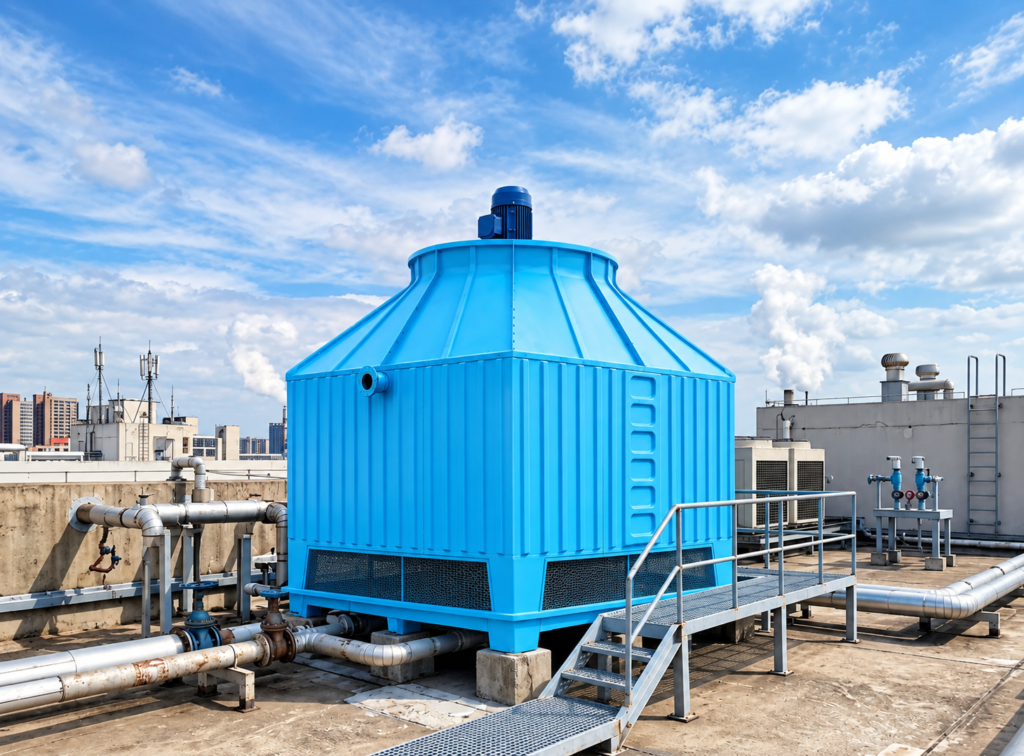
Why are Cooling Towers Essential?
Cooling towers are essential in industrial processes because they remove the waste heat that industrial machinery generates continuously and release it into the atmosphere before it can damage equipment or interrupt production. Without a working cooling tower, a plant running boilers, condensers, compressors, or reactors would have no way to shed that heat, leading to equipment failure, forced shutdowns, and process instability within hours, not weeks.
For plant managers and procurement teams, understanding why this equipment matters — not just how it works, is what makes the difference between treating a cooling tower as a line item and treating it as critical infrastructure. This guide covers how cooling towers work, why they’re non-negotiable across industrial sectors, and what commonly goes wrong when they’re mismanaged.
How Cooling Towers Work
Cooling towers work on a simple principle: evaporative cooling. A small amount of water evaporating carries a disproportionate amount of heat with it, which is why cooling towers can reject enormous heat loads using relatively little water and energy compared to other methods.
The cycle runs in four stages:
- Heat absorption: hot water carrying waste heat from plant machinery is pumped to the top of the tower
- Distribution: the hot water is sprayed across fill media, which spreads it into a thin film to maximise surface area
- Evaporation: fans draw ambient air across the falling water; a small fraction evaporates, pulling heat out of the remaining volume
- Recirculation: the cooled water collects in the basin below and is pumped back into the plant to absorb more heat, repeating the cycle
This is a simplified overview. For a full breakdown of tower types, fill media, and airflow configurations, see our complete guide: What Is a Cooling Tower and How Does It Work?
Why Cooling Towers Are Critical to Industry
Protecting Equipment From Heat Damage
Sustained heat warps metal components, breaks down lubricants faster than they can be replaced, and shortens the service life of electronics and seals. A cooling tower keeping process water within its designed temperature range is what keeps a multi-million-rupee compressor or condenser running for its intended lifespan instead of failing early.
Reducing Water and Energy Costs
Cooling towers recirculate water rather than drawing fresh water once and discharging it, which is why they remain the standard heat-rejection method across industry. That said, they aren’t loss-free: a typical tower loses roughly 1–1.2% of its circulating flow to evaporation for every 10°F of cooling achieved, plus periodic blowdown to control mineral buildup. Optimising cycles of concentration and blowdown scheduling is where real water savings come from, not the recirculation itself.
Enabling Uninterrupted 24/7 Production
Plants that run continuously, power generation, petrochemical refining, steel, cannot tolerate unplanned thermal shutdowns. A properly sized cooling tower provides a stable, continuous heat-rejection loop that keeps production running without temperature-related trips.
Maintaining Consistent Product Quality
In chemical manufacturing and plastics processing, reaction rates and mould-setting times are temperature-sensitive. Inconsistent cooling water temperature translates directly into inconsistent batch quality, which is why process engineers treat cooling tower performance as a quality-control input, not just a utility.
What Is a Cooling Tower?
A cooling tower is a heat-rejection device that removes waste heat from industrial process water by exposing it to moving air, allowing a small portion of the water to evaporate and carry heat away with it. The cooled water is then recirculated back to the process. It’s the mechanism that keeps compressors, condensers, and reactors from overheating during continuous operation. For a deeper explanation of the working principle and tower types, see our complete guide: What Is a Cooling Tower and How Does It Work?
Key Industries That Depend on Cooling Towers
Nearly every heat-intensive industrial process depends on cooling towers in some form, but the specifics differ by sector.
Power Generation
Power plants use cooling towers to condense the steam that drives their turbines, rejecting some of the largest heat loads of any industrial application. Reliability here is non-negotiable; a cooling tower failure can force a full plant shutdown.
Chemical & Petrochemical Processing
Refineries and chemical plants use cooling towers to keep exothermic reactions and distillation processes within safe operating temperatures. Water chemistry here is often aggressive, which shapes material selection toward corrosion-resistant construction such as FRP.
Pharmaceutical & Food Processing
These industries need precise, consistent cooling for fermentation, sterilisation, and packaging lines, alongside strict hygiene standards. Closed-circuit systems or FRP towers with stainless-steel internals are common here to avoid contamination risk.
Steel & Heavy Manufacturing
Steel mills and heavy manufacturing plants use cooling towers to manage continuous high heat loads from furnaces and rolling processes, often with water carrying scaling minerals that demand wider fill spacing and more frequent inspection.
Cooling towers also serve data centres and commercial HVAC systems, though Wet Point’s manufacturing focus is on the four heavy-industrial sectors above.
Cooling Towers vs Alternative Cooling Methods
Cooling towers aren’t the only way to reject industrial heat, but they’re usually the most practical for large, continuous loads. Here’s how they compare to the two main alternatives.
Method | How It Works | Water Use | Best Suited For |
Cooling Tower | Evaporative cooling with continuous water recirculation | Moderate — recirculates water, with evaporation and blowdown losses | Large, continuous industrial heat loads across most sectors |
Air-Cooled Chiller | Refrigerant cycle cooled by ambient air fans, no water contact | Minimal to none | Water-scarce sites or smaller loads where water use must be avoided |
Once-Through Water Cooling | Draws water from a river/well, uses it once, then discharges it | Very high — no recirculation | Largely phased out under modern environmental regulations |
Common Mistakes Industrial Plants Make With Cooling Towers
- Undersizing capacity to save upfront cost, then struggling to hit process temperatures once the plant scales up
- Skipping a formal water treatment program, which allows scale, corrosion, and biological growth (including Legionella risk) to build up unnoticed
- Ignoring drift and blowdown losses when budgeting water costs, leading to inaccurate operating cost projections
- Waiting until cooling performance visibly drops before inspecting fill media and nozzles, instead of following a preventive schedule
- Choosing tower material by price alone rather than matching it to the plant’s actual water chemistry
Maintenance Tips for Reliable Performance
Cooling tower reliability is largely a maintenance discipline rather than a design one. At a minimum:
- Inspect fill media and spray nozzles on a regular schedule, not just when performance drops
- Maintain a water treatment program to control scale, corrosion, and microbial growth
- Check drift eliminators periodically to limit water loss and airborne carryover
- Clean the basin on a set schedule to prevent sediment buildup and blockages
This is a summary only, see our full Cooling Tower Maintenance Checklist for a complete, schedule-based breakdown.
Buying Considerations for Industrial Cooling Towers
If you’re specifying a new cooling tower, the decision comes down to matching capacity, material, and draft type to your process data, water flow rate, inlet/outlet temperature, design wet bulb temperature, and water chemistry. Our complete buying guide and buyer’s checklist walk through this in detail before you request quotes.
In simple terms:
Cooling towers remove waste heat that would otherwise cause equipment failure and production downtime.
✓ They recirculate water rather than using it once, though evaporation and blowdown still account for real water loss.
✓ Power generation, chemical processing, pharma, and steel each place different demands on tower design and material.
✓ Most cooling tower failures trace back to skipped water treatment or delayed inspection, not equipment defects.
✓ Air-cooled chillers and once-through cooling are the main alternatives, but neither suits most large continuous industrial loads as well as a cooling tower.
Frequently Asked Questions
They remove the waste heat generated by continuous industrial operations, preventing equipment damage, unplanned shutdowns, and inconsistent product quality that would otherwise result from uncontrolled temperature rise.
Process temperatures rise uncontrolled, triggering automatic safety shutdowns in many systems, accelerating wear on compressors and condensers, and in continuous processes, risking product batch failure or equipment damage within hours.
Power generation, chemical and petrochemical processing, pharmaceutical and food manufacturing, and steel and heavy manufacturing are the largest industrial users, though HVAC systems and data centres also rely on them.
Cooling towers recirculate water instead of using it once and discharging it, which is why they’re standard for large heat loads. They still lose water to evaporation (roughly 1–1.2% of flow per 10°F of cooling) and periodic blowdown, so actual savings depend heavily on how well blowdown and cycles of concentration are managed.
A cooling tower uses evaporative cooling with water in continuous contact with air, while an air-cooled chiller rejects heat through a refrigerant cycle cooled by ambient air fans with no water use. Cooling towers are generally more efficient for large, continuous loads; air-cooled chillers suit smaller loads or water-restricted sites.
Fill media, nozzles, and drift eliminators should be checked on a set schedule, commonly monthly for visual inspection and quarterly for deeper checks, rather than only when cooling performance has already dropped. See our maintenance schedule guide for a full breakdown.
Yes, this is exactly what they’re designed for. Continuous-duty industrial cooling towers are built for uninterrupted operation, provided they receive scheduled maintenance and water treatment; skipping either is the most common cause of unplanned downtime.
Cooling towers aren’t a peripheral utility; they’re what allows heat-intensive industrial processes to run continuously, protect expensive equipment, and hold product quality steady. Whether you’re specifying a new tower or evaluating why an existing one is underperforming, the fundamentals are the same: match the tower to your actual heat load and water chemistry, and maintain it on a schedule rather than reactively.
Wet Point Aqua Equipments has manufactured cooling towers for power, chemical, pharmaceutical, and steel plants across India since 1996, across six series engineered for different industrial demands.
Talk to Our Engineering Team
Not sure if your current cooling tower is sized correctly? Contact us or explore our WDF, WRT, WJT, WCF, WST, and Pultruded series.