Why Choose Wet Point for Your Pultruded Cooling Tower
Wet Point Aqua Equipments has been engineering cooling tower systems from Gwalior since 1996, and our pultruded cooling towers are built for plants that cannot afford unplanned downtime. Every FRP structural member is pultruded in-house to consistent cross-sections, so load ratings don't vary from batch to batch the way they can with hand-laid FRP. We've supplied cooling systems to 100+ industrial clients - including BHEL, Tata Motors, Godrej, and Birla group units - across 50+ Indian cities, and our pultruded range carries the same engineering discipline as our WDF, WRT, WJT, and WCF series. If your process runs on corrosive water, sits in a coastal or high-humidity zone, or simply needs a structure that won't rust, warp, or need repainting every few years, this is the tower built for that job.
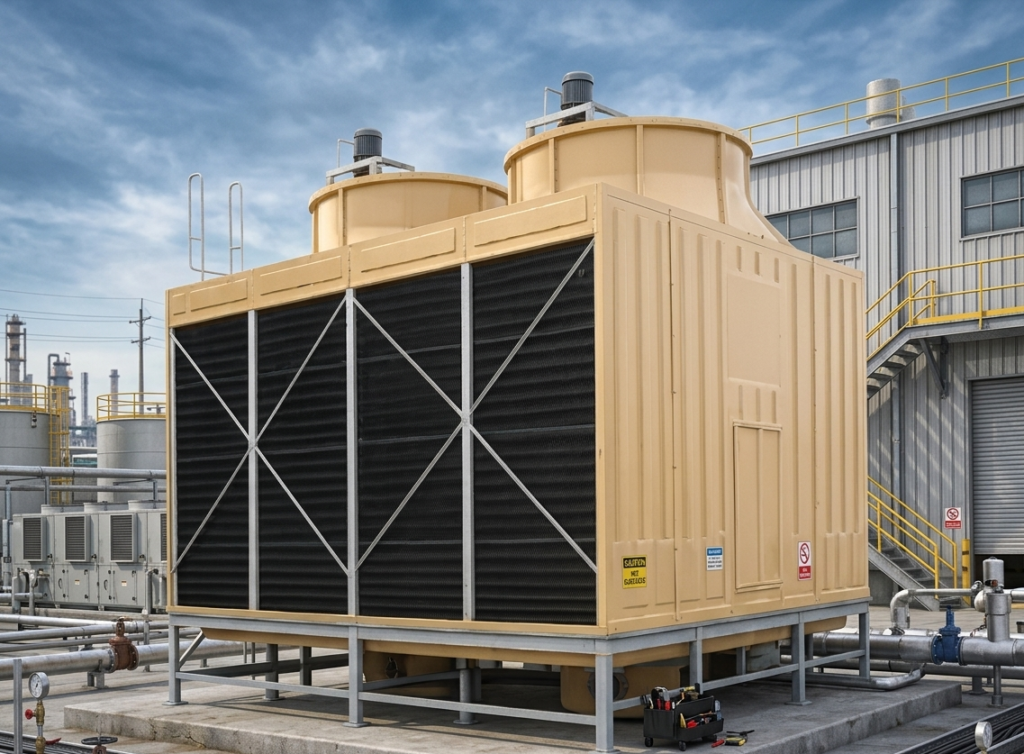
What Is a Pultruded Cooling Tower
A pultruded cooling tower is an induced-draft or forced-draft evaporative cooling system whose entire load-bearing structure – columns, beams, and cross-bracing – is made from pultruded fiber-reinforced plastic (FRP) instead of timber, mild steel, or hand-laminated FRP panels. Pultrusion is a continuous manufacturing process: glass fiber strands are pulled through a resin bath and then through a heated die, which cures the resin and locks the fibers into a fixed structural profile. The result is a component with uniform strength along its entire length, high stiffness-to-weight ratio, and zero susceptibility to rot, rust, or termite damage – the three failure modes that shorten the life of older timber and mild-steel towers.
Because the structure doesn’t corrode, pultruded towers hold their rated load capacity for decades with minimal structural maintenance, which is why they’ve become the standard upgrade path for plants replacing aging timber cooling towers.
In Simple Term
Pultruded Cooling Towers are engineered using advanced pultrusion technology, which produces high-strength fiber-reinforced plastic (FRP) structural components with superior durability and dimensional stability. These towers are designed to withstand harsh environmental conditions, offering excellent resistance to corrosion, chemicals, and UV exposure.
The pultruded framework provides exceptional load-bearing capacity while remaining lightweight, making installation easier and extending the overall service life. Equipped with efficient water distribution systems, high-performance PVC fills, and drift eliminators, pultruded cooling towers ensure optimal heat transfer and minimal water loss.
Pultruded FRP vs. Timber vs. Hand-Laid FRP
Plants typically compare three structural options when specifying a new tower. Timber towers are cheaper upfront but need periodic re-treatment, are prone to rot and termite damage in humid climates, and their load capacity degrades as the wood dries and shrinks over years of thermal cycling. Hand-laid (contact-molded) FRP panels avoid the rot problem but depend on the skill of the laminator – wall thickness and fiber distribution can vary panel to panel, which means load ratings are less predictable and joints are more prone to failure under vibration. Pultruded FRP removes both weaknesses: the profile is extruded through a fixed die under controlled resin content, so every meter of structural member carries the same fiber-to-resin ratio and the same rated strength. That consistency is the main reason plants running corrosive, high-TDS, or coastal water increasingly specify pultruded structures over both alternatives, even though the initial cost sits above timber.
How a Pultruded Cooling Tower Works
Hot process water enters through a header and lateral pipe network and is sprayed evenly over the fill media through non-clogging nozzles. As the water trickles down through PVC film or splash fill, an induced-draft fan pulls ambient air upward and across the falling water, driving evaporative heat transfer. Drift eliminators positioned above the fill catch airborne water droplets before they can escape with the exhaust air, limiting water loss to well within CTI-recommended drift limits. The cooled water collects in an FRP cold-water basin at the base and is recirculated back to the process. The pultruded FRP frame carries the entire mechanical and hydraulic load – fan deck, motor, fill stack, and water weight – without the sagging or joint failure that timber structures develop as wood dries and shrinks over time.
Applications and Industries We Serve
Pultruded cooling towers are specified wherever corrosion resistance and structural longevity matter more than upfront cost. Typical applications include chemical and petrochemical process cooling, pharmaceutical manufacturing (where corrosion-free, contamination-resistant materials are non-negotiable), power plant auxiliary cooling, steel and metal processing, textile and dyeing units, sugar and distillery plants, and any coastal or high-TDS-water facility where salt spray or hard water would degrade mild-steel structures within a few years. HVAC and central air-conditioning plants for large commercial and institutional buildings also use pultruded towers where low maintenance and long service life offset the higher initial investment. In each of these settings, the deciding factor is usually the same: the cost of a structural failure or unplanned shutdown far outweighs the price difference between a pultruded tower and a cheaper alternative, which is why procurement teams in these sectors treat structural material as a specification, not a negotiable line item.
Pre-Purchase Checklist
Before finalizing a pultruded cooling tower for your plant, confirm:
- Required heat load in TR or kcal/hr and the design wet-bulb temperature for your site
- Whether your water quality (TDS, hardness, suspended solids) calls for film fill or splash fill
- Available footprint and whether a single-cell or multi-cell layout fits
- Hardware grade needed for your corrosion environment (stainless steel vs. hot-dip galvanized)
- Whether you need CTI-certified thermal performance for compliance or client reporting
Sharing these five details with our engineering team lets us size and quote a tower in one round instead of several.
Get a Pultruded Cooling Tower Quote
Wet Point Aqua Equipments has been manufacturing cooling towers from Gwalior since 1996, with pultruded FRP systems engineered for plants that need structural longevity without a corrosion-driven replacement cycle. Share your heat load, water chemistry, and site conditions, and our team will size the right configuration and send a detailed quotation.
Frequently Asked Questions About WRT Series Cooling Towers
A pultruded cooling tower is an evaporative cooling system whose structural frame is built from pultruded FRP – fiberglass strands pulled through a resin bath and cured into fixed structural profiles. In simple terms: it’s a cooling tower with a rust-proof, rot-proof skeleton instead of timber or mild steel.
Regular (hand-laid) FRP panels are laminated by hand, so wall thickness and strength can vary panel to panel. Pultruded FRP is extruded through a fixed die, giving every structural member the same fiber-to-resin ratio and the same rated strength. In simple terms: pultruded is machine-consistent; hand-laid depends on the laminator’s skill.
Pultruded cooling towers typically last significantly longer than timber towers because the FRP structure doesn’t rot, rust, or degrade from thermal cycling. In simple terms: no wood, no rust, no shrinking joints – so the structure holds its rated strength for decades with minimal upkeep.
Chemical, pharmaceutical, power, steel, textile, and sugar/distillery plants use pultruded cooling towers, along with any coastal or high-TDS-water site where corrosion is a risk. In simple terms: anywhere corrosive water or salty air would eat through a mild-steel structure.
Yes, pultruded towers cost more upfront than timber towers, but they need far less structural maintenance and don’t require periodic re-treatment or replacement. In simple terms: higher purchase price, lower lifetime cost.
Spares and Components of Pultruded Cooling Tower:
Square Structure
Strong, corrosion-resistant FRP panels forming the square-shaped tower body, replaceable in sections.
PVC Fills (Film / Splash Type)
High-efficiency fill media designed to maximize heat transfer by increasing air-water contact surface area.
Drift Eliminators
Specially designed drift eliminators supported by galvanized frame are for minimizing the drift losses of the water as per shape
Water Distribution System
Includes header pipes, lateral arms, and spray arrangements ensuring uniform water distribution over the fill area.
Spray Nozzles
Non-clogging nozzles made from polypropylene/ABS for consistent spray pattern and efficient cooling performance.
Axial Fan Assembly
Energy-efficient induced draft fans with FRP/aluminium blades, designed for high airflow, low noise, and durability.
Electric Motor (TEFC Type)
Totally enclosed, flange-mounted motors suitable for continuous operation with high efficiency and insulation standards.
Air Inlet Louvers / Mesh
FRP or PVC louvers that allow proper airflow while preventing entry of debris and contaminants.
Cold Water Basin (FRP)
Leak-proof basin for collecting cooled water and ensuring smooth recirculation.
Support Structure Components
Hot-dip galvanized steel framework (angles, channels, rods) for strength, durability, and corrosion resistance.