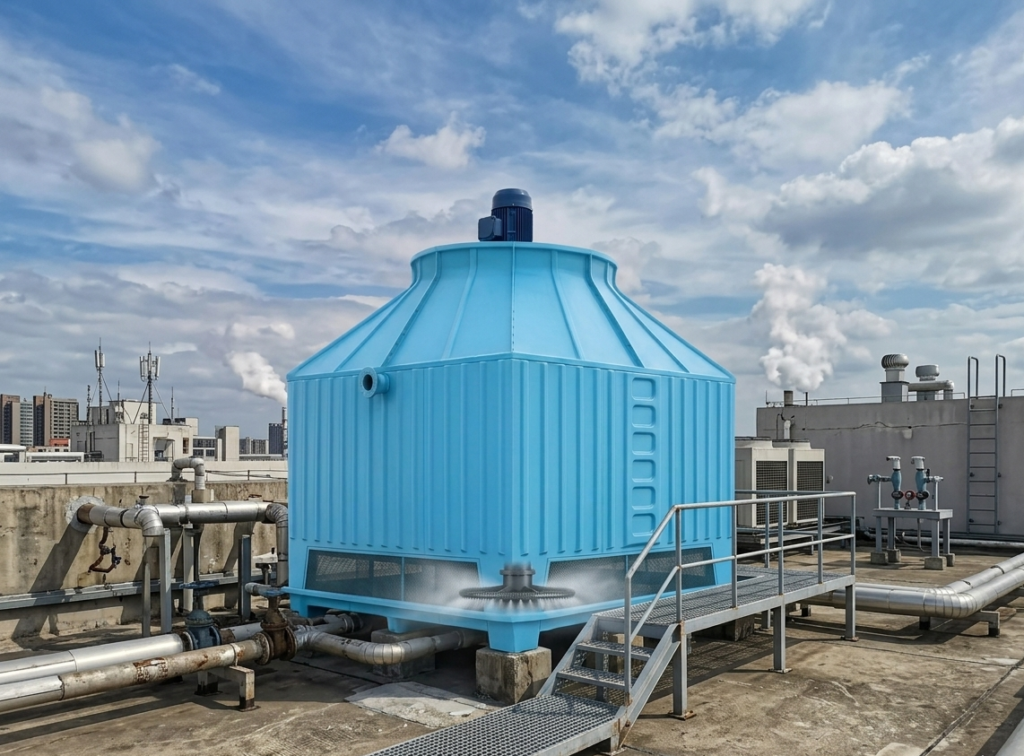
What is an FRP Cooling Tower?
FRP (Fibre Reinforced Plastic) cooling towers are factory-built, modular cooling towers where the casing, fills, fans, drift eliminators, and structural frame are made from fibreglass-reinforced plastic composites.
💡 In simple terms: An FRP cooling tower is a factory-made, corrosion-free cooling tower built from fibreglass plastic — lightweight, quick to install, and available in standard capacities from 5 TR to 10,000 TR.
FRP cooling towers come in induced draft, forced draft, cross flow, and pultruded variants. Most Indian industrial plants — chemical, pharma, HVAC, power — use FRP as the standard choice today.
What is an RCC Cooling Tower?
RCC (Reinforced Cement Concrete) cooling towers are large, permanent structures built on-site using concrete. The shell, basin, and structural frame are all cast in concrete. Fills, fans, drift eliminators, and distribution pipework are fitted inside the concrete structure.
distribution pipework are fitted inside the concrete structure.
💡 In simple terms: An RCC cooling tower is a permanent concrete structure built on-site — suitable for very large industrial capacities above 5,000 TR where permanence and very long structural life are priorities.
RCC towers are most commonly found in large power plants, refineries, and fertiliser complexes where capacity requirements exceed what pre-fabricated FRP units can deliver economically as single cells.
Key characteristics of RCC cooling towers:
● Built on-site — requires civil construction and significant lead time
● Typical capacity: 2,000 TR to 50,000 TR and above
● Permanent structure — cannot be relocated or expanded easily
● Concrete shell lasts 40–50 years; fills and fans replaced periodically
● High upfront civil construction cost
● Installation time: 6–18 months depending on scale
FRP vs RCC Cooling Tower — Cost Comparison
Cost is where most buyers make their decision — and where RCC looks deceptively attractive at first glance.
Cost Factor | FRP Cooling Tower | RCC Cooling Tower |
Initial equipment cost | Lower to moderate | Higher — civil work included |
Civil / foundation cost | Minimal — slab or platform only | Very high — full structure |
Installation time | 1–7 days | 6–18 months |
Installation labour cost | Low | Very high |
Fills replacement (15 yrs) | Low — standard FRP parts | Moderate — custom fit required |
Fan & motor replacement | Easy — standard components | Easy — standard components |
Painting / waterproofing | Not required | Required every 5–7 years |
Relocation cost | Possible — low cost | Not possible |
Total cost of ownership (20 yr) | Lower | Higher due to civil maintenance |
💡 In simple terms: For capacities below 5,000 TR, FRP cooling towers almost always have a lower total cost of ownership over 20 years — even when upfront equipment cost appears similar — because civil and maintenance costs for RCC compound significantly over time.
FRP vs RCC — Durability & Lifespan
Durability Factor | FRP Cooling Tower | RCC Cooling Tower |
Structural lifespan | 20–25 years | 40–50 years (concrete shell) |
Corrosion resistance | Excellent — immune to rust and scale | Moderate — concrete carbonates, rebar can corrode |
Chemical resistance | High — suited for aggressive water | Moderate — acid attack risk |
UV resistance | Good (UV-stabilised FRP) | Excellent |
Seismic / wind load | Lightweight — good flex resistance | Heavy — good but less flexible |
Fill lifespan | 10–15 years (replaceable) | 10–15 years (replaceable) |
Coastal / humid environments | Excellent | Moderate — rebar corrosion risk |
One important nuance: RCC’s 40–50 year shell life sounds impressive, but the fills, fans, and distribution systems inside both tower types last the same 10–15 years regardless of whether the shell is FRP or concrete. You’re replacing the internals on the same schedule either way.
Maintenance: Which Type Costs Less to Run?
Cooling towers aren’t the only way to reject industrial heat, but they’re usually the most practical for large, continuous loads. Here’s how they compare to the two main alternatives.
FRP cooling tower maintenance:
● Annual inspection of fills, nozzles, and drift eliminators
● Fan blade and bearing check every 6 months
● No painting, waterproofing, or concrete repair required
● Spare parts are standard and widely available across India
● Basin cleaning 2–4 times per year depending on water quality
RCC cooling tower maintenance:
● All of the above, plus:
● Concrete crack inspection and sealing every 2–3 years
● Waterproofing treatment every 5–7 years
● Rebar exposure repair as required — especially in coastal and humid areas
● Higher scaffold/access cost for inspection of tall RCC structures
💡 In simple terms: FRP cooling towers cost significantly less to maintain over their lifetime. RCC adds concrete repair, waterproofing, and rebar treatment costs that compound every 5 years. For plants below 5,000 TR, this difference is hard to justify.
FRP vs RCC Cooling Tower — Full Comparison Table
Factor | FRP Cooling Tower | RCC Cooling Tower | Winner |
Initial cost | Lower to moderate | High (civil included) | ✅ FRP |
Installation speed | 1–7 days | 6–18 months | ✅ FRP |
Structural lifespan | 20–25 years | 40–50 years (shell) | ✅ RCC |
Corrosion resistance | Excellent | Moderate | ✅ FRP |
Maintenance cost | Low | High (concrete + rebar) | ✅ FRP |
Capacity range | 5 TR – 10,000 TR | 2,000 TR – 50,000 TR | Depends on need |
Relocation | Possible | Not possible | ✅ FRP |
Chemical resistance | High | Moderate | ✅ FRP |
Total cost (20 yr) | Lower | Higher | ✅ FRP |
Best for | Most industrial plants | Very large power/refinery | Depends on scale |
Which Cooling Tower is Right for Your Plant?
Choose FRP if:
- Your capacity requirement is below 5,000 TR
- You need fast installation — project timelines don’t allow 6–18 months of civil work
- Your plant is in a chemical, pharma, HVAC, or food processing industry with aggressive water chemistry
- You want lower total cost of ownership over 20 years
- The installation site is a rooftop or existing structure with load limitations
- You may need to relocate or expand the cooling system in future
Choose RCC if:
- Your capacity requirement exceeds 5,000 TR as a single installation
- You are building a large power plant, refinery, or fertiliser complex with a 40+ year project life
- Long-term structural permanence is more important than flexibility or fast deployment
- Civil construction budget is already allocated and the project timeline accommodates 12–18 months
What About Pultruded FRP Cooling Towers?
If you like the corrosion resistance of FRP but need the structural strength closer to RCC, pultruded FRP cooling towers are worth considering. Pultruded FRP uses a manufacturing process that produces structural sections (like fibreglass I-beams and channels) with higher strength and stiffness than standard hand-laid FRP.
💡 In simple terms: Pultruded FRP cooling towers give you the structural strength approaching RCC, with zero corrosion and 30% lighter weight — no painting, no rust, no concrete repair. Best for heavy industrial and coastal environments.
Feature | Standard FRP | Pultruded FRP | RCC |
Structural strength | Good | Very high | Excellent |
Corrosion resistance | Excellent | Excellent | Moderate |
Weight | Light | Light-medium | Very heavy |
Cost | Moderate | Higher | Very high (civil) |
Lifespan | 20–25 yr | 25–30 yr | 40–50 yr shell |
Best for | General industrial | Coastal, chemical, heavy industrial | Very large power plants |
In simple terms:
Cooling towers remove waste heat that would otherwise cause equipment failure and production downtime.
✓ They recirculate water rather than using it once, though evaporation and blowdown still account for real water loss.
✓ Power generation, chemical processing, pharma, and steel each place different demands on tower design and material.
✓ Most cooling tower failures trace back to skipped water treatment or delayed inspection, not equipment defects.
✓ Air-cooled chillers and once-through cooling are the main alternatives, but neither suits most large continuous industrial loads as well as a cooling tower.
Frequently Asked Questions
Is FRP better than RCC for cooling towers?
For most industrial plants, yes. FRP cooling towers are better for capacities below 5,000 TR because they cost less to install, require less maintenance, resist corrosion better, and can be deployed in days rather than months. RCC is only the better choice for very large power plants and refineries where capacity exceeds what modular FRP can deliver economically.
A well-maintained FRP cooling tower lasts 20–25 years. The FRP casing and structure resist corrosion throughout this period without painting or concrete repair. Internal fills and drift eliminators typically need replacement every 10–15 years — the same replacement interval as the internals inside an RCC tower.
The initial cost of an FRP cooling tower is generally lower than an equivalent RCC installation when civil construction costs are included. RCC requires foundation work, formwork, concrete pouring, and waterproofing — which can add 30–50% to total project cost compared to an FRP unit on a simple slab. Over 20 years, FRP’s lower maintenance cost (no concrete repair, no repainting) further widens the cost advantage.
Yes — FRP cooling towers are specifically recommended for chemical, pharmaceutical, and coastal applications where cooling water contains chemicals, high TDS, or biological treatment agents that would corrode galvanised steel or react with concrete. The fibreglass composite is chemically inert across most industrial water treatment conditions.
Wet Point Aqua Equipments Pvt. Ltd. is a leading FRP cooling tower manufacturer in India, based in Gwalior, Madhya Pradesh. Wetpoint manufactures standard FRP, induced draft, forced draft, cross flow, and pultruded FRP cooling towers from 5 TR to 10,000 TR — with installations across power plants, chemical, pharma, and HVAC industries in 50+ cities since 1996. View the full FRP cooling tower range →
Conclusion — Which Should You Choose?
Here’s the short version:
- FRP cooling tower: faster, cheaper, lower maintenance, better corrosion resistance — right for 95% of Indian industrial plants
- RCC cooling tower: permanent, very high capacity, long shell life — right for large power plants and refineries above 5,000 TR
- Pultruded FRP: best of both — high structural strength, zero corrosion, no civil construction — ideal for heavy industrial and coastal environments
If you’re still unsure, the right cooling tower depends on your exact wet bulb temperature, site conditions, water quality, and capacity requirement. A reliable cooling tower manufacturer in India will size and specify the right type for your application — not push a standard catalogue model onto your project.
📞 Get a free cooling tower quote: wetpointcoolingtowers.com | +91-9302-214-784 | Gwalior, Madhya Pradesh
WORDPRESS IMPLEMENTATION CHECKLIST
- Focus keyword: FRP cooling tower — set in Yoast / RankMath
- Secondary keywords: FRP cooling tower manufacturer, RCC cooling tower, pultruded FRP cooling tower, cooling tower cost India
- FAQPage JSON-LD schema — add for all 5 FAQ questions via RankMath FAQ block
- Featured image: FRP vs RCC side-by-side hero (1200×630px)
- Add all 6 internal links per the interlink table on page 1
- Category: Cooling Tower Knowledge | Tags: FRP cooling tower, RCC cooling tower, cooling tower types, cooling tower cost
- Author byline: Wetpoint Engineering Team | 30+ years FRP cooling tower manufacturing
- Related articles at bottom: link to “Induced Draft vs Forced Draft” article, WDF Series page, Pultruded Series page
- Table of Contents — enable in RankMath or use an Elementor TOC widget pointing to H2 IDs
Talk to Our Engineering Team
Not sure if your current cooling tower is sized correctly? Contact us or explore our WDF, WRT, WJT, WCF, WST, and Pultruded series.