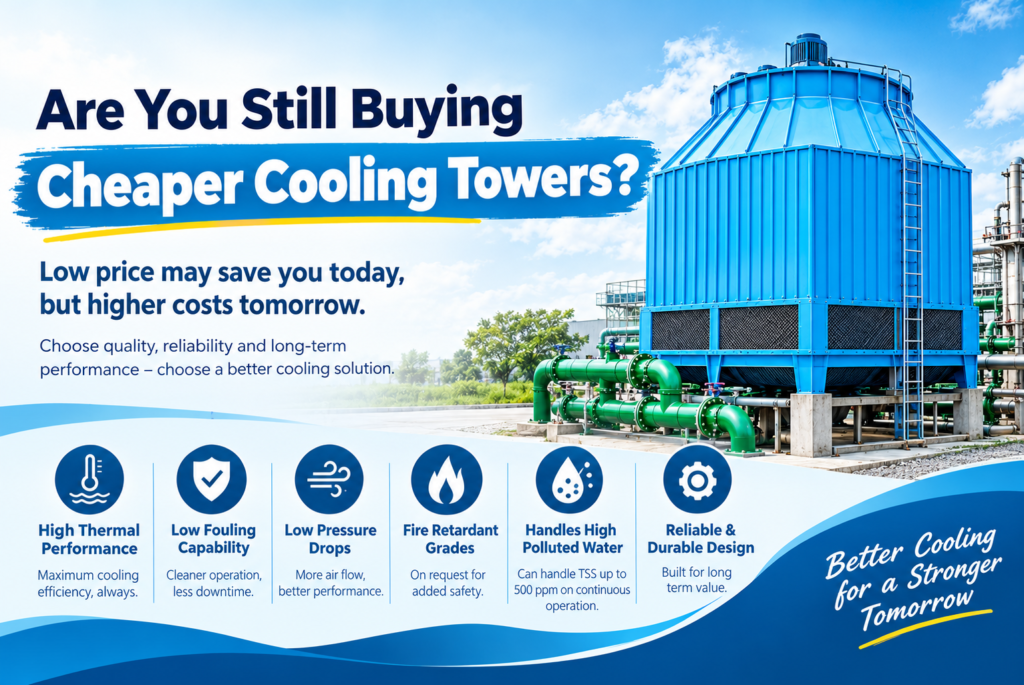
Are You Still Buying Cheaper Cooling Towers?
COOLING TOWER BUYING GUIDE
Are You Still Buying Cheaper Cooling Towers?
Published by Wetpoint Aqua Equipments Pvt Ltd · Gwalior, India
Quick answer: Do not compare cooling towers by price or TR capacity alone. Compare design conditions, fan and airflow, components, construction materials, water-quality suitability and service support, on a like-for-like basis.
Imagine you are planning a new plant or replacing an existing cooling tower. You receive three quotations from different suppliers. All three appear to offer similar cooling capacity, but one supplier provides a much lower price.
Which one would you choose?
For many purchase managers, the lowest quotation looks attractive. After all, a cooling tower may represent only a small part of the total project budget. Reducing the initial purchase cost can seem like a sensible decision.
However, the cheapest cooling tower is not always the most economical choice in the long run.
Differences in design, fan selection, fill quality, construction materials and water distribution can affect how a cooling tower performs and how much attention it needs during operation.
For plant owners, project engineers and maintenance teams, the important question is not simply how much a cooling tower costs. It is whether the proposed equipment is suitable for the actual cooling requirements.
In this article, we will explore six common mistakes to avoid when buying cheap cooling towers and explain what to check before approving a quotation.
Why Can a Cheaper Cooling Tower Become an Expensive Decision?
A cooling tower helps remove unwanted heat from circulating water. If it does not meet the process requirements, the consequences may extend beyond the equipment itself.
For example, imagine a manufacturing plant that selects a cooling tower mainly because its quotation is lower than competing offers. During operation, the plant discovers that the proposed configuration does not meet its actual cooling requirements under the specified operating conditions.
The team may then need to investigate the problem, review the design or consider modifications. Depending on the situation, these issues can create additional costs and operational difficulties.
This does not mean that every low priced cooling tower is poorly designed. A lower quotation may reflect a simpler configuration, different materials, manufacturing efficiencies or a different scope of supply.
The real risk is comparing prices without comparing what each supplier is offering.
Before making a decision, examine the design, components, operating conditions, construction quality and available support.
6 Mistakes to Avoid When Buying Cheap Cooling Towers
1. Choosing a Cooling Tower by TR Capacity Alone
Cooling tower quotations often mention capacity in tons of refrigeration (TR). Although capacity is an important consideration, the TR figure alone does not provide enough information to judge whether two cooling towers are equivalent.
The required cooling tower performance depends on factors such as:
- Hot water temperature entering the tower
- Cold water temperature required at the outlet
- Wet bulb temperature at the installation location
- Water flow rate
- Heat load and operating conditions
Two suppliers may quote the same nominal capacity but use different design conditions or configurations. Their proposals should not automatically be treated as equivalent.
What should you do? Ask each supplier to provide the design conditions and technical details used to calculate the proposed capacity. Compare the specifications against your actual process requirements rather than relying on the TR figure alone.
2. Overlooking Cooling Tower Size, Airflow and Fan Selection
A cooling tower depends on the interaction between water flow, airflow, heat transfer surfaces and the overall design.
If you compare quotations without examining these details, you may overlook important differences between the proposed units.
Review the cooling tower dimensions, fan diameter, fan design, operating speed and motor power. These details help you understand what has been included in each proposal.
Fan speed alone does not establish performance, and a larger fan or higher motor rating does not automatically mean a better cooling tower. The complete design must suit the required duty.
What should you do? Request the relevant technical specifications and compare them under the same operating conditions. Ask the manufacturer to explain how the proposed fan and airflow arrangement meets your cooling requirements.
3. Saving Money on Fans, Motors, Fills and Nozzles
A cooling tower contains several components that contribute to its operation. Differences in component selection can affect performance, maintenance requirements and replacement needs.
Before approving a low priced quotation, review the following:
- Fan and motor: Check their specifications, power requirements and suitability for the intended operating conditions.
- PVC fills: Review the fill type, material and configuration proposed for heat transfer.
- Water distribution system: Check the proposed sprinklers, headers and nozzles to understand how water will be distributed.
- Drift eliminators: Confirm the proposed arrangement and specifications.
- Other components: Check which items are included in the quotation and which are optional.
A lower price does not automatically indicate inferior components. However, a quotation that provides limited component details makes it harder to judge the actual value of the equipment.
What should you do? Ask for a component list with specifications. Compare the materials, designs and included items instead of assuming that similar looking quotations contain equivalent components.
4. Ignoring the Quality of the Structure and Materials
The cooling tower structure and casing must suit the installation environment and operating requirements.
Different designs may use different materials and construction methods. For example, a cooling tower with an FRP casing may have a different configuration from one built using another structural material.
When reviewing quotations, examine the material specifications, structural arrangement, corrosion considerations and accessibility for inspection and maintenance.
Do not judge structural quality only by appearance or purchase price.
What should you do? Ask the supplier to specify the materials used for the casing, supporting structure and other major parts. Confirm that the proposed construction is appropriate for your plant environment and installation requirements.
5. Buying a Cooling Tower Without Considering Water Quality
Water quality is another factor that deserves attention before selecting a cooling tower.
The water circulating through a system may contain dissolved minerals, suspended solids or other substances that influence deposits, fouling and maintenance requirements. The actual impact depends on the water chemistry, operating conditions and water treatment practices.
A configuration suitable for one application may not be the best choice for another.
For example, the fill type and water distribution arrangement should be reviewed in light of the water conditions and the possibility of deposits or blockages.
What should you do? Share your available water quality information with the cooling tower supplier. Discuss the expected operating conditions, water treatment arrangements and suitable component options before finalising the design.
6. Choosing a Supplier Without Checking Service Support
A cooling tower is an industrial asset that may require inspection, maintenance, troubleshooting and replacement parts during its operating life.
A low purchase price may appear attractive, but the value of the quotation is harder to assess if the supplier does not clearly explain the support available after delivery.
Before placing an order, clarify the warranty terms, documentation, spare parts availability, technical assistance and any service arrangements included in the offer.
Do not assume that every supplier provides the same level of support.
What should you do? Ask the manufacturer to explain the support available for your location and application. Request the relevant terms in writing so that you understand what is included before committing to the purchase.
Cheap Cooling Tower vs Properly Evaluated Cooling Tower
The following comparison shows why it is important to review the complete proposal rather than focusing only on the initial price.
| What to compare | When focusing only on price | When evaluating the complete proposal |
|---|---|---|
| Cooling capacity | Compare the stated TR figure | Check the design conditions and required duty |
| Size and airflow | Assume similar capacity means similar design | Review dimensions, fan details and airflow requirements |
| Components | Focus on the total quotation | Compare fan, motor, fills, nozzles and other specifications |
| Structure | Compare appearance or basic material descriptions | Review construction materials and suitability for the environment |
| Water quality | Use a standard configuration without discussing conditions | Discuss water chemistry, treatment and suitable component options |
| Service support | Assume support is included | Confirm warranty, technical assistance and service terms |
| Overall cost | Focus on the initial purchase amount | Consider purchase cost, operating needs and potential maintenance expenses |
A properly evaluated cooling tower does not necessarily have to be the most expensive option. The goal is to select equipment that meets the required duty, provides clear specifications and fits the plant’s operating needs.
What Should You Check Before Approving a Cooling Tower Quotation?
Before finalising your purchase, use this checklist to compare quotations more confidently.
- Confirm the required cooling duty and design conditions.
- Check hot water temperature, cold water temperature, water flow rate and local wet bulb temperature.
- Request technical specifications for the proposed cooling tower.
- Compare fan design, fan diameter, motor power and operating details.
- Review the type and specifications of fills, nozzles and drift eliminators.
- Confirm the construction materials and structural arrangement.
- Share water quality details and discuss any application specific requirements.
- Check the scope of supply and identify optional items.
- Clarify warranty terms, technical support and spare parts arrangements.
- Compare the total proposal on a like for like basis rather than choosing by price alone.
Following these steps can help purchase managers and engineers identify differences between quotations before placing an order.
Talk to Wetpoint today
Tell us your flow rate, temperatures, wet bulb and water quality, and we will help you compare specifications and support before you decide.
How Wet Point Cooling Towers Can Help You Evaluate Your Requirements
Selecting a cooling tower starts with understanding the application. The equipment should be evaluated against the required cooling duty, operating conditions, installation environment and expected maintenance needs.
Wet Point Cooling Towers, from Wetpoint Aqua Equipments Pvt Ltd, provides cooling tower product information, including details of its WST Series.
The WST Series information describes components such as FRP casing, rigid PVC honeycomb fill, induced draft axial fans, motors, drift eliminators, water distribution headers and polypropylene nozzles. The specific configuration and available options should be confirmed for your application.
1. Clarifying Your Cooling Requirements
Share your required water flow rate, inlet and outlet water temperatures, local wet bulb temperature and application details. This provides a basis for discussing the proposed cooling tower design.
2. Understanding Components and Construction
Request details of the proposed fans, motors, fills, nozzles, casing and other relevant components. This helps you compare the equipment with other quotations on a more consistent basis.
3. Discussing Water Conditions
Provide available water quality information and explain your water treatment arrangements. Ask which configuration and components are suitable for the expected operating conditions.
4. Comparing Quotations Fairly
Share the technical specifications you are comparing and identify differences in design, materials, scope of supply and included components. A clear comparison makes it easier to understand why quotations differ in price.
5. Confirming Support Before Purchase
Discuss warranty conditions, documentation, spare parts and technical assistance. Confirm the actual terms available for your equipment before placing an order.
The objective is not simply to purchase a cooling tower at a lower price. It is to make an informed decision based on the equipment’s suitability, specifications and overall value.
Frequently Asked Questions About Buying Cheap Cooling Towers
No. A lower priced cooling tower may be suitable if it meets the required cooling duty, uses appropriate components and offers acceptable construction quality. The important step is to compare the technical specifications and scope of supply before making a decision.
The stated TR capacity does not explain every design condition or component detail. Water flow rate, inlet and outlet temperatures, local wet bulb temperature and other operating requirements must also be considered when evaluating a cooling tower proposal.
They can, depending on the component specifications, operating environment and quality of maintenance. However, price alone does not establish component quality. Review the materials, technical specifications, expected operating conditions and replacement requirements.
Water chemistry and suspended solids can influence fouling, deposits, blockages and maintenance needs. Sharing water quality information with the supplier helps identify suitable design and component options for the application.
Compare the cooling duty, design conditions, dimensions, fan and motor specifications, fills, nozzles, construction materials, scope of supply, warranty terms and available support. Make sure each supplier is quoting against the same requirements.
Ask how the proposed design meets your cooling requirements, which components and materials are included, whether the configuration suits your water conditions, what documentation will be provided and which warranty or technical support arrangements apply.
Looking for the Right Cooling Tower for Your Plant?
The lowest quotation may reduce the initial purchase cost, but price alone cannot tell you whether a cooling tower is suitable for your application.
Before making your decision, compare the cooling duty, design details, components, construction materials, water conditions and support arrangements. These checks can help you understand the differences between supplier quotations and choose equipment that fits your plant’s needs.
Wetpoint Aqua Equipments Pvt Ltd
Call: 9302214784
Email: wetpointcoolingtowers@gmail.com
Make your next cooling tower purchase based on technical suitability and value, not price alone.