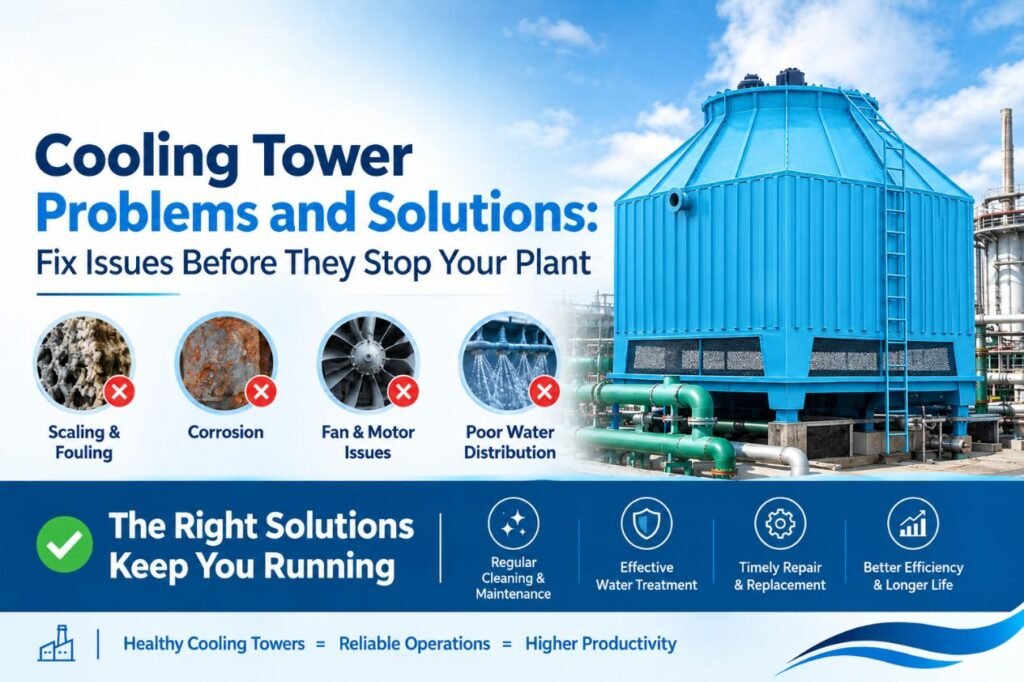
Cooling Tower Problems and Solutions: Fix Issues Before They Stop Your Plant
Cooling Tower Problems and Solutions: Fix Issues Before They Stop Your Plant
Quick answer
Common Cooling Tower Problems in Industrial Plants
| Problem | What you notice | What it costs you |
|---|---|---|
| High process water temperature | Cold water returns warmer than usual, especially in summer | Slower production, product quality risk, machine stress |
| High fan motor power consumption | Motor draws more current; electricity bill creeps up | Higher running cost and motor overheating |
| Excessive water loss | Makeup water use keeps rising; basin level keeps dropping | Wasted water and treatment chemicals |
| Vibration and noise | Shaking, rattling or grinding from the fan deck | Damaged gearbox, bearings and fan; breakdown risk |
| Scaling or choking of fills | White or brown deposits, slime, poor water flow over the fill | Reduced cooling and higher approach temperature |
| Water leakage from basin or pipeline | Wet patches, dripping flanges, cracks in the basin | Water loss, corrosion and unsafe, slippery surroundings |
Cooling Tower Problems and Solutions (Sample Problems with Fixes)
1. High Process Water Temperature
- Why it happens: fan blades set at the wrong pitch, a slipping belt or drive, choked sprinklers causing uneven water spread, a scaled or dirty fill, clogged drift eliminators, or a tower that is now handling more load than it was sized for.
- How to spot it: watch the approach, which is the gap between your cold water temperature and the local wet-bulb temperature. If that gap keeps growing, your tower is losing performance. Hot spots on the fill and dry patches under the sprinklers are also giveaways.
- The fix: clean or flush the sprinklers, correct the fan blade setting, clean or replace the fill, clear the eliminators, and confirm the water flow matches the tower’s rating.
2. High Power Consumption of Fan Motor
- Why it happens: blade pitch set too steep, a fill or eliminator clogged with deposits, worn bearings, a misaligned drive or gearbox, or a motor that has aged.
- How to spot it: compare the motor’s running current with the nameplate value and with its own earlier readings. A steady rise, with no change in load, is a warning sign. Heat and a burning smell from the motor are late signs.
- The fix: reset the blade angle, clean the air path, check lubrication and alignment, and replace worn bearings or belts before they damage the motor.
3. Excessive Water Loss in Cooling Tower
- What is normal: a cooling tower cools by evaporating a small part of the water. As a rough guide, about 1.2% of the circulating water evaporates for every 10°F (around 5.5°C) of cooling. Drift, the fine mist carried out by the air, is typically around 0.05% to 0.2% of the circulation rate.
- What is not normal: overflowing basins from a faulty float valve, leaking joints, sprinklers throwing water outside the fill, broken drift eliminators, and blowdown left running without control.
- The fix: repair leaks, adjust or replace the float valve, correct the sprinkler spray, replace damaged eliminators, and review blowdown with your water treatment provider.
4. Vibration and Excessive Noise in Cooling Tower
- Why it happens: an unbalanced or damaged fan blade, loose fasteners, worn bearings, a misaligned drive shaft, a gearbox running low on oil, or a fan deck that has loosened over time.
- How to spot it: shaking you can feel on the fan deck, a rhythmic thumping, grinding or squealing, or oil leaks near the gearbox.
- The fix: shut the fan down, inspect the blades and hub, tighten fasteners, rebalance or replace blades, realign the drive, and renew bearings or gearbox oil as needed.
5. Scaling or Choking of Fills
- Why it happens: hard water, high concentration of dissolved solids, weak water treatment, dust and debris entering the tower, and algae or slime growth in warm, sunlit water.
- How to spot it: white or brown crust, slime or sludge on the fill, uneven water flow, and a gradual rise in water temperature.
- The fix: clean the fill, remove debris, replace fill sections that are too damaged to clean, and work with your water treatment provider to keep scale and growth under control.
6. Water Leakage from Basin or Pipeline
- Why it happens: ageing gaskets, loose flanges, corroded pipes, a cracked or worn basin, and faulty float valves or overflow arrangements.
- How to spot it: wet patches around the basin and pipework, staining, dripping at joints, and makeup water use that rises with no change in load.
- The fix: replace gaskets, tighten or reseal joints, repair or coat the basin, and fix or replace damaged pipe sections.
A five-minute walk-around your team can do every week
- Listen for unusual noise or vibration when the fan is running.
- Look at the spray pattern. Dry spots or uneven water spread point to blocked sprinklers.
- Check the basin level and look around the basin and pipes for wet patches.
- Note the cold water temperature and the fan motor current, and compare them with last week.
- Write down anything odd and share it with your service team. Small notes now save big repairs later.
Tired of Cooling Tower Problems?
Talk to Wet Point today
Email: wetpointcoolingtowers@gmail.com
Tell us what you are seeing, and we will help you decide the next step.
Wet Point's Cooling Tower Service and Maintenance Solutions
Inspection by Trained Technicians
Basic Adjustments: Fan Blade Setting, Sprinkler Setting and Leakage Arrest
Preventive Maintenance with Genuine, Affordable Spare Parts
Quick Response for Emergency Breakdowns
Annual Maintenance Contract (AMC) for a Trouble-Free Cooling Tower
Scheduled Visits for Performance and Health Check-Ups
Inspection Report After Every Visit
Basic Corrective Actions Included
Priority Emergency Breakdown Support
Why Choose Wet Point for Cooling Tower Maintenance?
- Operation of your cooling tower is our responsibility. We treat your tower as ours to keep running.
- Trained technicians who inspect, adjust and report clearly.
- Genuine spare parts are in stock at low cost, so repairs do not drag on.
- Experience: Wet Point has been in the cooling tower business since 1996 and is ISO 9001 certified.
- Support for industrial areas across Pan India, including [write location name]
FAQs on Cooling Tower Problems
The most common reasons are low airflow from a wrongly set or damaged fan, blocked sprinklers, and a scaled or dirty fill. Start by checking the fan blade setting, the sprinkler spray pattern and the condition of the fill. If the cold water temperature keeps rising, get the tower inspected.
Check that the fan blade angle is correct, keep the fill and eliminators clean so air flows freely, and maintain bearings, belts and gearbox alignment. Compare the motor’s running current with its nameplate value regularly. A steady rise is a signal to inspect.
Evaporation and a small amount of drift are normal. Extra loss usually comes from leaking flanges or basins, an overflowing basin due to a faulty float valve, damaged drift eliminators, sprinklers spraying outside the fill, or uncontrolled blowdown.
A cooling tower should get scheduled inspections through the year, not just a repair when it fails. The right frequency depends on the tower, your operating hours and your water quality, and an AMC with scheduled visits is the easiest way to keep it regular.
A Wet Point AMC includes scheduled visits for a basic performance and health check-up, an inspection report after each visit highlighting concern points, basic corrective actions such as fan blade setting, sprinkler setting and leakage arrest, and emergency breakdown support on a preference basis.
Get Your Cooling Tower Checked by Wet Point Experts
Call: 9302214784
Email: wetpointcoolingtowers@gmail.com
Operation of your cooling tower is our responsibility, so call us for further details.