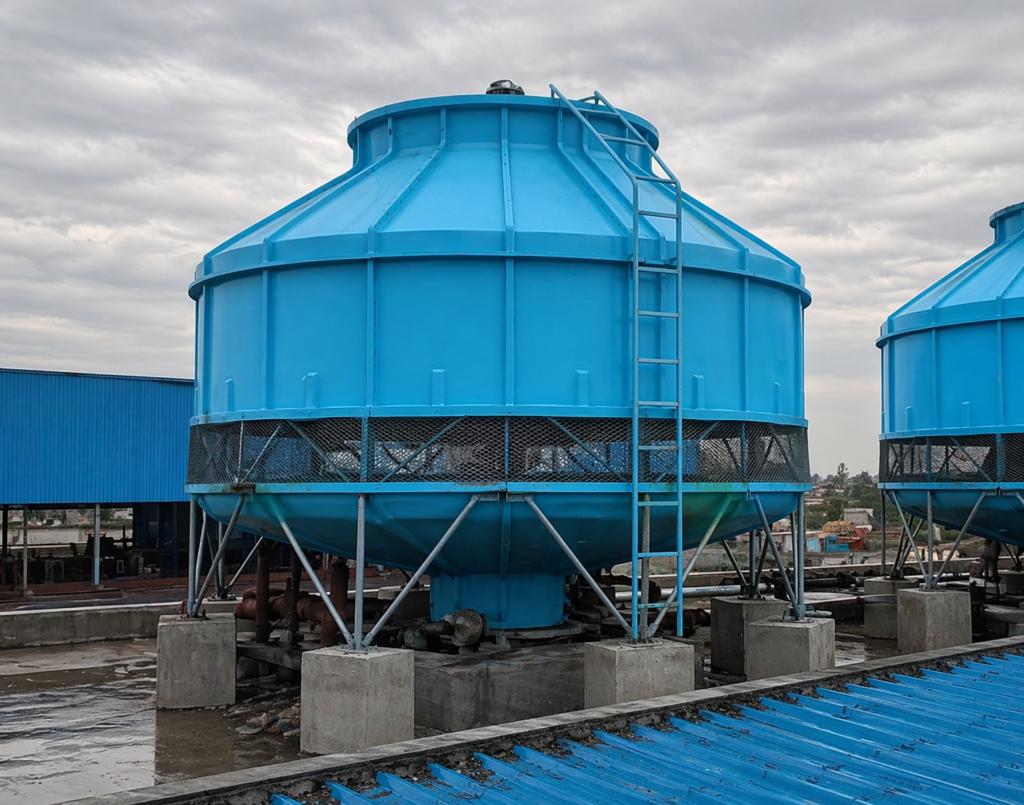
Cooling Tower Manufacturer
Choosing the wrong cooling tower manufacturer is not a mistake you notice in week one. It shows up two years in, as corrosion nobody warned you about, a spare part nobody stocks, or a supplier who has quietly stopped answering the phone. For plants running power generation, chemical processing, pharmaceutical, or steel operations, the cooling tower is not a peripheral purchase; it directly affects uptime, energy cost, and compliance.
This guide walks through how cooling towers work, the types and materials available, how to match a tower to your industry, and what separates a genuine manufacturer from a trader reselling someone else’s equipment. Wet Point Aqua Equipments has been manufacturing cooling towers from its Gwalior, Madhya Pradesh facility since 1996, and this guide draws on that three-decade manufacturing experience.
Why Choose Wet Point Aqua Equipments as Your Cooling Tower Manufacturer
Before comparing specifications, it helps to know who you’re buying from. Here is what three decades of manufacturing looks like in practice.
30+ Years of Manufacturing Experience Since 1996
Wet Point Aqua Equipments has been designing and manufacturing cooling towers from Gwalior since 1996. Over 500 projects and 50+ cities across India later, that track record means the engineering team has already solved most of the site-specific problems a new plant is likely to run into – corrosive water chemistry, space-constrained rooftops, high-altitude wet bulb variations, and everything in between.
Six Series Engineered for Every Industry
Rather than a single generic tower resized for every order, Wet Point manufactures six distinct series, each built around a different operating priority:
- WDF Series – robust, consistent performance for long operational life in demanding industrial environments
- WRT Series – advanced heat dissipation engineered for medium to large-scale industrial loads
- WJT Series – a cost-effective, durable option for steady cooling with minimal upkeep
- WCF Series – high-strength construction for superior airflow in demanding conditions
- WST Series – a compact, space-saving footprint without sacrificing efficiency
- Pultruded Series – premium pultruded FRP structure for maximum corrosion resistance and service life
Built to Indian Standard Design Specifications
Wet Point cooling tower is manufactured against a documented set of design parameters – wet bulb temperature, approach, range, drift loss, and noise level – rather than vague marketing claims. This design data is shared openly with buyers before manufacturing begins, so you know exactly what performance you’re being quoted against. The full specification table is further down this guide.
Trusted by 100+ Industrial Clients Across Power, Chemical, Pharma & Steel
Wet Point’s client base spans power plants, manufacturing units, chemical industries, and HVAC systems – over 100 industrial clients and 15,000+ customers served across categories, including names in cement, pharmaceuticals, auto components, and heavy engineering. That breadth matters because it means the manufacturing team has direct experience solving for each industry’s specific water chemistry and duty-cycle demands, not a one-size-fits-all catalogue.
What Is a Cooling Tower?
A cooling tower is a heat-rejection device that removes waste heat from industrial process water by exposing it to moving air, allowing a small portion of the water to evaporate and carry heat away with it. The cooled water is then recirculated back to the process. It’s the mechanism that keeps compressors, condensers, and reactors from overheating during continuous operation. For a deeper explanation of the working principle and tower types, see our complete guide: What Is a Cooling Tower and How Does It Work?
Types of Cooling Towers We Manufacture
Cooling towers are classified by how air moves through them and how that airflow interacts with the water. Getting this choice right affects both cooling efficiency and long-term energy cost.
Induced Draft vs Forced Draft
Induced draft towers pull air upward through a fan mounted at the top, which keeps the fan out of the humid air stream and reduces recirculation of warm exhaust air back into the intake. Forced draft towers push air in from the bottom using a fan at the base, which is simpler to maintain but more prone to recirculation and ice formation in cold climates. Most Indian industrial installations favour induced draft for this reason.
Cross Flow vs Counter Flow
In cross flow towers, air moves horizontally through the falling water, making the fill media easy to access for cleaning and inspection. In counter flow towers, air moves vertically upward against the falling water, which typically gives a smaller footprint and slightly higher thermal efficiency per unit of size, at the cost of harder-to-access fill media.
Open Circuit vs Closed Circuit
Open circuit (direct contact) towers expose the process water directly to air, which is simple and cost-effective but means the water is exposed to atmospheric contamination. Closed circuit towers keep the process fluid inside a sealed coil, with a separate water circuit doing the evaporative cooling on the outside – used where water purity is critical, such as in pharmaceutical processes.
Applications Across Industries
The right cooling tower depends heavily on what’s running through it and what’s in the water. Here’s how requirements shift by sector.
Power Generation Plants
Power plants run cooling towers continuously, often at large capacities, to reject heat from boilers and condensers. Reliability and minimal unplanned downtime matter more than compactness here, which is why larger installations sometimes lean toward RCC / Timber construction, while FRP remains common for mid-sized plants and coastal sites with high chloride exposure.
Chemical & Petrochemical Refineries
Power plants run cooling towers continuously, often at large capacities, to reject heat from boilers and condensers. Reliability and minimal unplanned downtime matter more than compactness here, which is why larger installations sometimes lean toward RCC / Timber construction, while FRP remains common for mid-sized plants and coastal sites with high chloride exposure.
Pharmaceutical & Food Processing
These industries prioritise hygiene and consistent water quality alongside cooling performance. Closed-circuit systems or FRP towers with stainless-steel internals are common choices, since non-porous, corrosion-resistant materials are easier to keep clean and don’t introduce contamination risk into a controlled environment.
Steel & Heavy Manufacturing
Steel plants generate high heat loads and often handle water with scaling potential from dissolved minerals. Towers here typically need wider fill spacing to resist clogging, along with robust structural design to handle continuous high-duty operation without frequent shutdowns for maintenance.
FRP vs Timber - Choosing the Right Material
Steel plants generate high heat loads and often handle water with scaling potential from dissolved minerals. Towers here typically need wider fill spacing to resist clogging, along with robust structural design to handle continuous high-duty operation without frequent shutdowns for maintenance.
| Factor | FRP (Fiberglass Reinforced Plastic) | Timber |
|---|---|---|
| Corrosion resistance | Excellent – does not rust or degrade from water chemistry | Moderate – prone to decay, fungal attack, and moisture damage if not properly treated |
| Weight & installation | Lightweight, faster to install, lower foundation load | Heavy structure, requires skilled labor and longer on-site assembly time |
| Best suited for | Chemicals, pharma, food processing, HVAC, mid-size industrial loads | Large-scale industrial cooling where traditional designs and high water loads are involved |
| Maintenance | Low – no repainting or rust treatment required | High – requires regular inspection, chemical treatment, and replacement of worn-out wood parts |
| Typical use case in India | Most new installations and replacements across mid-size industry | Mostly older installations and specific heavy industries gradually shifting to modern alternatives |
Standard Technical Specifications
Ask any manufacturer for their standard design data sheet before you sign off on a quote – it tells you what performance you’re actually being promised. These are Wet Point’s standard design parameters:
Parameter | Standard Value |
Relative Humidity | 80% |
Design Wind Pressure | 100 MPH |
Vibration Level | 2 mm/sec |
Noise Level | 25 dB |
Drift Losses | 0.001% |
Evaporation Losses | 0.5% to 2.5% |
Maximum Hot Temperature | 80°C |
Maximum Range | 50°C |
Minimum Approach | 2°C |
Design Wet Bulb Temperature | 28°C |
What to Check Before You Buy - 5-Point Checklist
Every credible manufacturer will ask you for the same core data before quoting. Having it ready before you call speeds up the process and gets you a more accurate quote:
- Water flow rate and required cooling capacity (in LPM or m³/hr) for your process
- Inlet and outlet water temperature, plus the design wet bulb temperature for your site’s location
- Water chemistry and quality – this determines whether FRP, Timber, or stainless steel internals are the right call
- Available space and any noise restrictions, especially for rooftop or urban installations
- After-sales service and spares availability – ask specifically how long the manufacturer has stocked parts for towers sold 5+ years ago
What to Check in comparing offer with competitors
Cooling tower pricing varies too widely to quote a fixed number responsibly – it depends on capacity, material, and site conditions specific to each order. What you can control is understanding the variables that drive that price, so quotes from different manufacturers are actually comparable:
- Capacity – Temperature drop, approach and quantity of water in LPM or per m³/hr of water handled; larger capacity generally lowers per-TR cost
- Material – FRP typically costs less upfront than Timber for mid-size installations, though Timber can be more economical at very large scale
- Draft type – induced draft towers usually cost more upfront than forced draft but lower long-term energy and recirculation losses
- Fill media – high-efficiency fill costs more but reduces the size (and cost) of the rest of the tower needed for the same duty
- Site conditions – foundation work, piping runs, and access constraints can add significantly to installed cost beyond the tower itself
- After-sales package – service visits, spares stocking, and warranty terms should be itemised separately, not bundled invisibly into the headline price
The most reliable way to compare is to send the same specification sheet – capacity, water temperatures, material, and site conditions – to two or three manufacturers and request itemised quotes. Reject any quote that doesn’t break down material, freight, installation, and after-sales cost separately.
In simple terms:
✓ A cooling tower manufacturer’s track record and design transparency matter as much as the tower itself.
✓ FRP suits most industries needing corrosion resistance; Timber suits very large-scale power and heavy industry.
✓ Induced draft with counter flow is the most common efficient configuration for Indian industrial sites.
✓ Always request the manufacturer’s standard design data sheet before comparing quotes.
✓ Get itemised quotes covering material, freight, installation, and after-sales support – not just a headline number.
FRP (Fiberglass Reinforced Plastic) towers are lightweight, corrosion-resistant, and faster to install, making them the common choice for chemical, pharma, and mid-size industrial plants. Timber towers are heavier, site-built structures generally reserved for very large power and heavy-industry installations where scale outweighs the benefits of a lighter material.
Capacity is calculated from your water flow rate, the inlet and outlet water temperatures your process requires, and the design wet bulb temperature for your location. A manufacturer’s engineering team should size the tower from this data rather than a rough capacity guess.
Look for ISO 9001 quality certification as a baseline, and ask whether the manufacturer’s product line has CTI (Cooling Technology Institute) thermal performance certification, which independently verifies that a tower performs as rated. Not every credible Indian manufacturer holds CTI certification, so also weigh manufacturing track record and client references alongside paperwork.
Yes. Capacity, material, fill type, fan configuration, and internal components can all be adjusted for a specific process, water chemistry, and site layout. This is why sharing your full specification data upfront leads to a more accurate, purpose-built quote rather than a generic catalogue tower.
With proper maintenance, FRP cooling towers commonly run 15–20+ years, while RCC structures can last even longer but require more upkeep – periodic coating, crack repair, and structural inspection – to reach comparable lifespans.
Yes. Wet Point manufactures from its Gwalior, Madhya Pradesh facility and has delivered over 500 projects across 50+ cities in India, serving power, chemical, pharmaceutical, and manufacturing clients nationwide.
Choosing a cooling tower manufacturer in India comes down to three things: a design you can verify against real specifications, a material matched to your water chemistry and industry, and a manufacturer with a track record of standing behind what they sell after installation. Wet Point Aqua Equipments has been manufacturing against exactly this standard from Gwalior since 1996, across six dedicated series built for different industrial demands.
If you’re ready to size a cooling tower for your plant, share your water flow rate, inlet/outlet temperature, and site details with our engineering team for a specification-backed quote.
Get a Custom Cooling Tower Quote
Talk to Wet Point’s engineering team – contact us or browse the WDF, WRT, WJT, WCF, WST, and Pultruded series.